This official publication in the Royal Thai Government Gazette presents the “Standards for Website Security Version 1.0,” issued by the National Cyber Security Agency (NCSA) pursuant to the Cybersecurity Act B.E. 2562 (2019). The standards establish minimum security requirements for all websites connected to the internet, encompassing government agencies, critical information infrastructure entities, and private-sector organizations providing information or electronic services to the public. The primary objective is to elevate baseline security practices, mitigate risks of cyberattacks, intrusions, or unauthorized data manipulation, and strengthen public trust in digital platforms as part of a broader national cybersecurity agenda.
The framework is structured around two interdependent dimensions. The first is governance, which emphasizes organizational policies, risk management, and accountability. Agencies are required to designate responsible officers, maintain clear cybersecurity policies, conduct risk assessments, and develop both incident response and business continuity plans. Equally, the standards underscore the necessity of staff training and sustained awareness programs to ensure that technical measures are supported by human competence and institutional culture.
The second dimension concerns technical operations, outlining essential controls to be implemented at the system level. These include secure access management, robust authentication mechanisms such as multi-factor authentication (MFA), and strong password policies. Websites must employ encryption protocols such as SSL/TLS to secure data in transit and must configure web servers and databases to minimize vulnerabilities. The standards also mandate protective infrastructure, including firewalls and web application firewalls (WAF), and require defenses against common cyber threats such as SQL Injection, Cross-Site Scripting (XSS), and Distributed Denial of Service (DDoS) attacks. Furthermore, organizations must adopt secure Domain Name System (DNS) practices and maintain systematic monitoring to detect anomalies or breaches in real time.
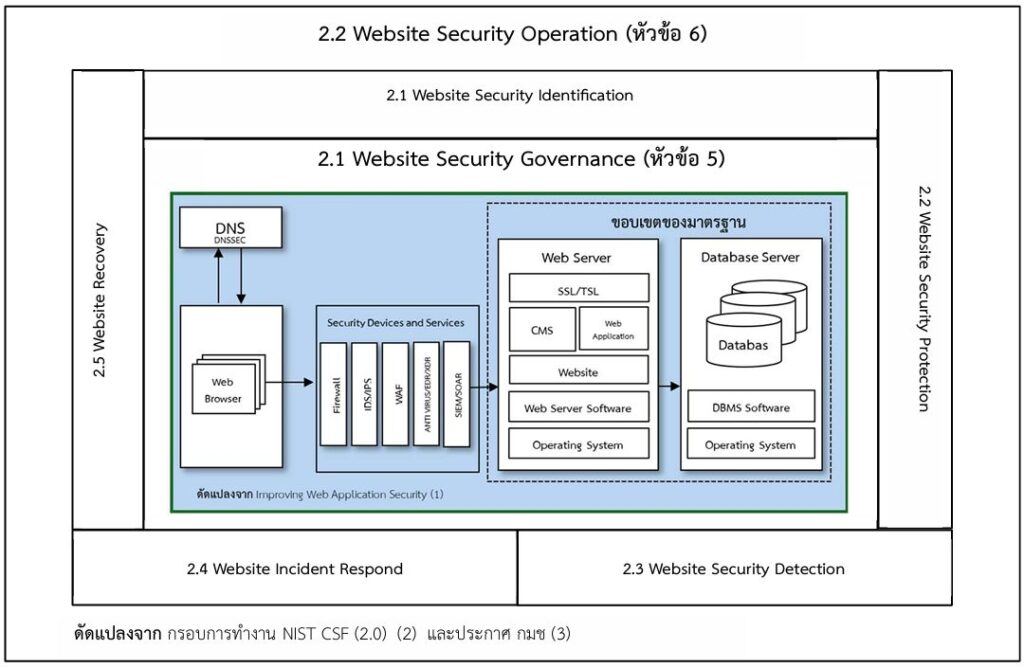
A critical feature of the standards is the provision of compliance checklists and self-assessment tools, enabling organizations to evaluate their own readiness and adherence. Importantly, the document clarifies that these requirements constitute a baseline, not a ceiling. Organizations are encouraged to adopt stricter or more advanced measures as appropriate to their unique operational contexts, risk profiles, and technological landscapes.
In essence, this publication provides not only a regulatory framework but also a strategic blueprint for the secure management of digital platforms. By codifying minimum standards and promoting continuous vigilance, it seeks to harmonize practices across sectors, reduce systemic vulnerabilities, and fortify the digital infrastructure that underpins Thailand’s governance, commerce, and social services. Ultimately, the standards reinforce cybersecurity as a matter of national resilience, ensuring that digital transformation proceeds with trust, stability, and long-term sustainability.
Expert Commentary – PKF Cyber Team Perspective
From the standpoint of cybersecurity professionals at PKF Thailand, the “Standards for Website Security Version 1.0” provide a solid regulatory foundation that addresses both governance and technical operations. The baseline requirements ensure that critical digital assets are safeguarded against the most common cyber threats, such as unauthorized access, data breaches, and web-based attacks, while promoting a culture of continuous monitoring and risk assessment.
However, in practice, merely meeting the baseline may not be sufficient for organizations handling highly sensitive or high-volume transactional data. The PKF Cyber team recommends augmenting these standards with advanced threat detection mechanisms, automated vulnerability management, and regular penetration testing to proactively identify and remediate security gaps. Emphasis should also be placed on continuous staff training, incident response simulations, and integration of security with broader IT governance frameworks.
Overall, compliance with the standards establishes credibility and risk reduction, but proactive adoption of enhanced cybersecurity practices is critical to achieving a resilient and sustainable security posture, particularly for organizations integral to national digital infrastructure.
Citation:
National Cyber Security Agency. (2023). Standards for website security Version 1.0 [Royal Thai Government Gazette]. Office of the Government Gazette. https://ratchakitcha.soc.go.th/documents/86192.pdf