Executive Summary
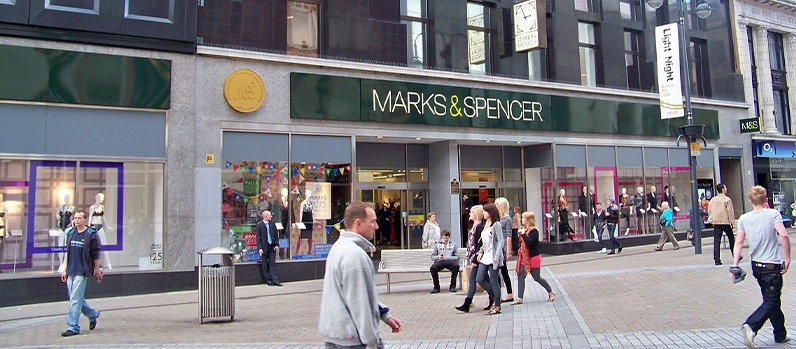
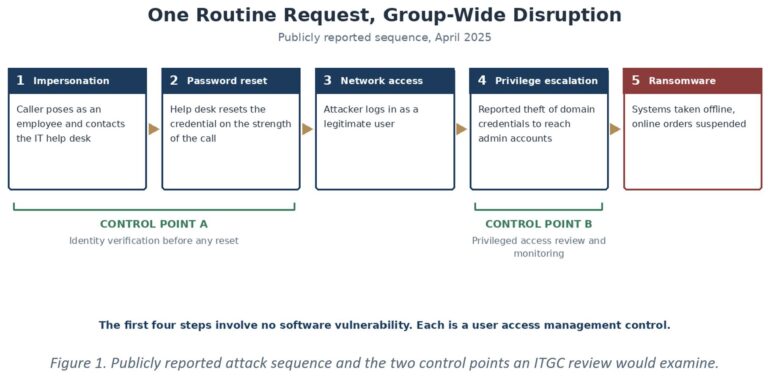
In April 2025, UK retailer Marks & Spencer (M&S) suffered a ransomware attack that suspended online clothing orders for 46 days and, by the company’s own disclosure, reduced operating profit by approximately £300 million. Public reporting indicates the intrusion began with a routine request: an attacker, reportedly impersonating an employee, persuaded an IT help desk to reset a credential.
The case is instructive for IT assurance because the reported entry point was not a software vulnerability. It was a user access management control, namely how a help desk verifies identity before resetting access. This is a control that can be designed, documented and tested in an IT general controls (ITGC) review.
1. The Incident
M&S disclosed a cyber incident in late April 2025 after customers reported problems with contactless payments and click-and-collect services. Online clothing and home orders were suspended, and the business reported a material impact on operating profit for the financial year. In July 2025, UK authorities arrested four individuals in connection with attacks on UK retailers, including M&S.
Details of the intrusion have emerged through media reporting and company statements rather than a full public investigation report. Several elements below are therefore described as reported and should not be read as established findings.
2. Control Design Versus Observed Practice
A help desk exists to restore access quickly. That purpose creates a built-in tension with security: the faster a reset is processed, the less time is spent on verification. A well-designed control resolves the tension through a defined verification standard that does not depend on information an attacker can obtain.
- Reported practice. A caller presenting as an employee was reportedly able to obtain a password reset. If so, the verification step relied on information that can be gathered from public profiles, prior breaches or social engineering.
- Expected control. Reset requests are verified through an independent channel, such as a call back to a registered number or approval from the user’s line manager, and the verification is recorded.
- Reported escalation. Once inside, the attackers reportedly obtained domain credentials and moved to administrative access before deploying ransomware. This points to a second control question: whether privileged access was reviewed and monitored closely enough to detect the escalation.
3. Why This Is Testable in an ITGC Review
Unlike management-directed fraud, which can defeat the controls that management itself operates, a help desk reset process is a routine, high-volume control. An IT audit can examine it directly:
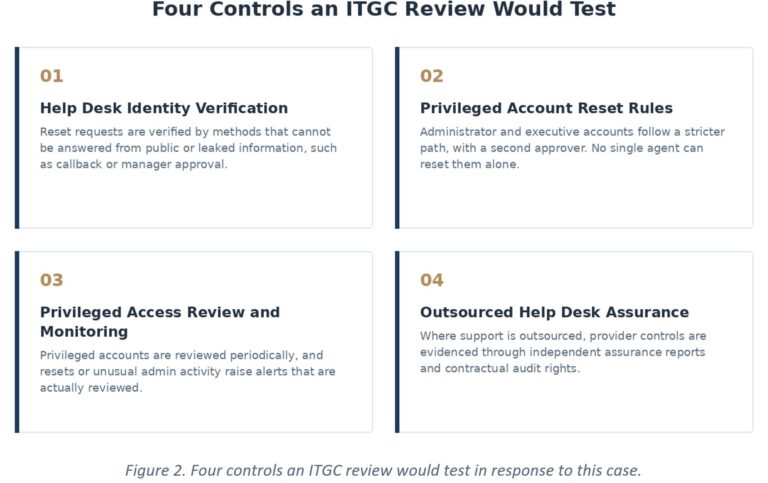
- Inspect the written verification procedure and compare it to the standard expected for the risk.
- Select a sample of reset tickets and test whether verification was performed and evidenced.
- Test whether privileged and executive accounts follow a stricter reset path with a second approver.
- Review how privileged accounts are inventoried, reviewed and monitored, and whether alerts are acted upon.
- Where help desk support is outsourced, confirm what assurance the organization holds over the provider.
4. Recommended Control Responses
None of these controls requires new technology. They require a defined standard, consistent execution and evidence that the standard is followed. The outsourced help desk point is relevant because public reporting has linked the attackers’ access to third-party support arrangements; the service provider has stated that it found no indicators of compromise in its own systems. The lesson is not about any one provider. It is that outsourcing a function does not outsource accountability for the control.
5. Relevance for Thai Listed Entities
Listed entities in Thailand rely on shared service desks, outsourced IT support and centralized identity platforms in the same way as large retailers. The access management and third-party oversight expectations that an ITGC review applies are the same. Boards and audit committees can ask a practical question: if a caller asked our help desk to reset an executive’s credential today, what would stop it?
About This Series
The PKF Thailand IT Assurance Insight Series examines real, recent cases through the lens of IT general controls, showing where controls would be tested and what good practice looks like. Each article focuses on one case.
For a discussion of how your organization’s access management and help desk controls would perform under review, please contact PKF Audit (Thailand) Ltd., IT Audit & Advisory.
Question for readers:
when did your organization last test whether its help desk could be persuaded to reset a privileged account?
Sources:
- The Record: M&S profits wiped out by cyberattack
- The Register: M&S restores click and collect
- CSO Online: Warning issued to retailers and CISOs after three attacks in UK
#ITAssurance #ITGC #InternalControls #AccessManagement #InternalControls #Cybersecurity